10 Things I Learned in My Second Year as a Full-Time Writer
After over two decades of lawyering, I became a full-time novelist in 2024. This industry switch has been eye-opening, to put it mildly! In law, there is a clear—albeit difficult—path to entry (LSAT, law school, bar exam) and in law firms, clear metrics for success (bill a ton of hours, bring in clients, make partner). Schedules in BigLaw are set by clients/other partners. Continuing Legal Education is required in some states, not all. We are paid handsomely for our minds and stamina (not physical, thank goodness). And if you want to practice law, you have to go through the aforementioned gates. One cannot simply manifest one’s desire to be a lawyer.
Not so in the writing industry! ANYONE can write! Or learn about writing! Or practice writing! Or get published (self- or traditionally)! You can write whenever you want! About whatever you want! If no one will publish your book or essay or story, you can throw it up on the internets or Substack!
And thus, it’s taken me two years + to kinda figure out the situation and here are the 10 biggest lessons learned from my second year in the writing trenches:
10. There Are Infinite Ways to Spend Money as an Unpublished Writer!
There are a million writing classes, services, retreats, webinars, Substacks and programs out there in addition to the gold standard writing credential, an MFA. I’ve dabbled in everything over the past two years - an online creative writing master’s program (dropped out after one too many irritating classes and the startling realization I don’t need to pay for another degree to write a novel; I could just. . . write a novel.) I enrolled in The Novelry. Several StoryStudio Chicago classes. Conferences online and in person. Every webinar on author websites and platforms and how to start a newsletter (shout-out to Jane Friedman). Agents and writers’ podcasts and (paid) newsletters and manic social media. I subscribed to all the writing Substacks. I made a giant list of the hundreds of residencies, conferences, and workshops I’d heard were prestigious.
I loved everything! I love learning. But somewhere along the way, I realized: there is an entire industry out there consisting of content creators targeting the unpublished (someone said this on a podcast once in the snarkiest voice imaginable and I honestly love it). A lot of pay-to-play programs that promise agents or shortcuts to publication. Agents who charge for query letters or sell, on their personal websites, multiple courses, books and webinars on how to get an agent. While many are helpful and offer wise advice, others capitalize on the very human insecurity and fear of failure that comes with putting your words (and heart and soul) out into the world through an opaque industry that is, based on most accounts, dying.
The BigLaw lesson: It’s all very different from law! If a rando decides one day to proclaim “I’m a lawyer” and then starts a website/online courses/Substack/retreats for people who want to be lawyers, that is a legitimate crime. Yet there is no “unauthorized practice of writing” felony or misdemeanor. Thusly, I have developed some discernment this year. (And also, I started feeling very nostalgic for law!)
Next year's plan: Learning about my craft and the business of writing is more like continuing legal education—while I could happily take nothing but classes, it's not my full-time job. My full-time job is writing a novel people will buy.
9. I Finally Understood When I Was "Finished" with My Novel!
My novel is about a female founder torn between her bohemian best friend and their billionaire angel investor as they race to take their jewelry company public (dun-dun-DUNNNN!)
After two years of working on this manuscript (and a year of thinking about it before that)—having rewritten the story several times over, then countless structural, developmental, character, dialogue, line editing, and copy editing drafts—I woke up one day knowing I was done. Like I had well-cooked this baby and it was time to give birth by sharing it with potential agents.
Letting go felt like artistic maturity. Or maybe just dead-ass exhaustion? Either way, I did it! I was scared I’d hoard the book forever and never, ever finish it because it is so hard to revise (and revise, and revise) but ever since I decided to query agents, I haven't opened that manuscript again.
The biglaw lesson: In law, there's always a clear deadline—the deal signing, the bank drawdown, the court date, the board meeting, the IPO. It's never just la-la-la, let me rework this contract a thousand times until all the SYMBOLISM is perfect! No. You just get things done by the time they need to be done.
Next year’s plan: I'll take more of my biglaw "get it done" mindset and know when to send out my next manuscript to beta readers (targeting March 1, baby) and also, I hope and pray I one day get a book deal so I have more deadlines! I love deadlines!
8. I Pitched My First Agents!
In August, I attended an online conference and signed up to pitch two agents over Zoom. It felt so official! I was SO nervous until a former colleague reminded me that I've pitched a gazillion times as a lawyer. Once I remembered I'm basically just trying to sell myself and my work product, I felt better (though of course, pitching my story-baby is more vulnerable than pitching my environmental law expertise to a sweet little energy company). Also, I got my hair done and bought new clothes. The whole experience made me feel very official!
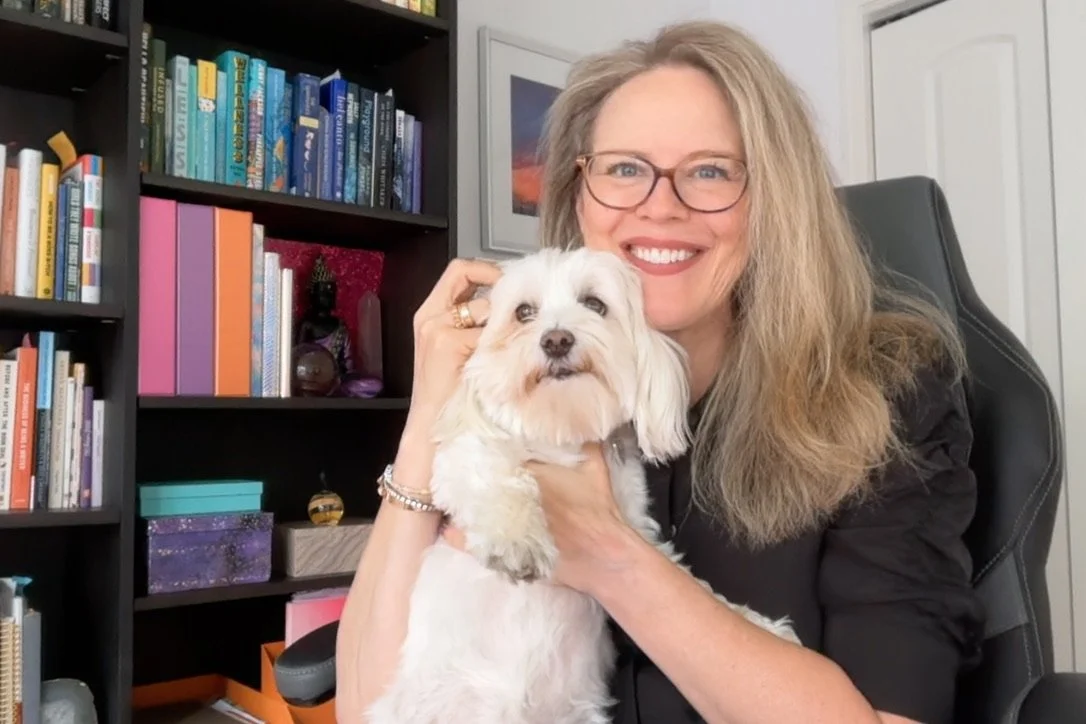
Hair by Matt Ryan; Top by Frame; Jewelry by Hermes and Cartier; Dog by Tiny N Tall Rescue
7. I Started Querying!
In September 2025, I clicked send on my first written queries. (Queries are short letters sent to literary agents explaining the book premise, comparable recent novels, why you wrote the book, a short bio and that’s about it. You only need an agent if you want to publish your book with a “traditional” publisher (like Penguin Random House). If agents are intrigued, they ask to see pages of your manuscript. If they make an offer of representation, and you accept, they then try to sell your manuscript to publishers and negotiate the terms of the deal. Agents earn 15% of the book/film deal.
I followed the guidance to send very small batches of queries then await feedback to analyze the data and tweak as necessary. It takes 8-12 weeks for agents to respond, if at all. Although I’ve yet to hear from some agents (ghosting is a whole thing!) and I’ve only otherwise received form rejections, the moment I sent those queries, something shifted. I wasn't just "working on a novel" anymore. I was a writer attempting to enter the marketplace with a finished product.
Next Year’s plan: Keep going with my queries until I meet “my” agent or, failing to connect with my top choices, try to publish my female founder novel with independent presses. Get ‘er done.
6. Rejections! So Many Rejections!
Another lesson learned this year, and one that makes you understand why #1 exists: to write is to be rejected and/or criticized. And it’s not just query rejections per the above. But rejections from application-based writing workshops and programs. Literary magazines that didn’t want my (admittedly amateur and very first) short story. Writing contests (that charge $$ to enter! See #1 above). My favorite: a rejection from Amazon Affiliates program (I hadn’t met the three sales threshold in three months on this blog, lol)!
Every rejection stings and every rejection means I am trying. I'm learning to metabolize it with bubble baths.
Next Year’s Goal: I want to get published, baby! So I'm obviously going to keep sending things out until I get a yes, but more judiciously. I shan’t waste a rejection-bubble bath on Amazon, for example. I want to apply to two different writing residences and submit at least 4 short stories to literary magazines, and pitch an essay or two about law and writing.
5. I Met My Hero Authors at Events—And One Day, They Might Be My Peers?!
In 2025, I attended some wonderful readings, panels, book launches, book festivals (mostly with my little sister and sometimes alone) and I met some of my favorite authors ever! Just hearing them talk about their work and their process and feeling their overall vibe IRL — it was so inspirational. And later, when I was practically in tears having talked to David Wroblewski about his novels, my sister called him my “peer.” I snorted. But then I realized: maybe one day my books will reside down the shelf from his and that would be AMAZING.
The possibility—however distant—keeps me going. To keep the inspo alive, I made a Canva collage of me and my sister with all the authors we met this year including Pulitzer Prize nominees, Oprah's Book Club winners, and New York Times number one bestsellers. In at least one case (Shelby Van Pelt), I petted the author’s hair. Assuming she did not later seek a restraining order against me, perhaps one day I will meet her again at a book reading for my own work!
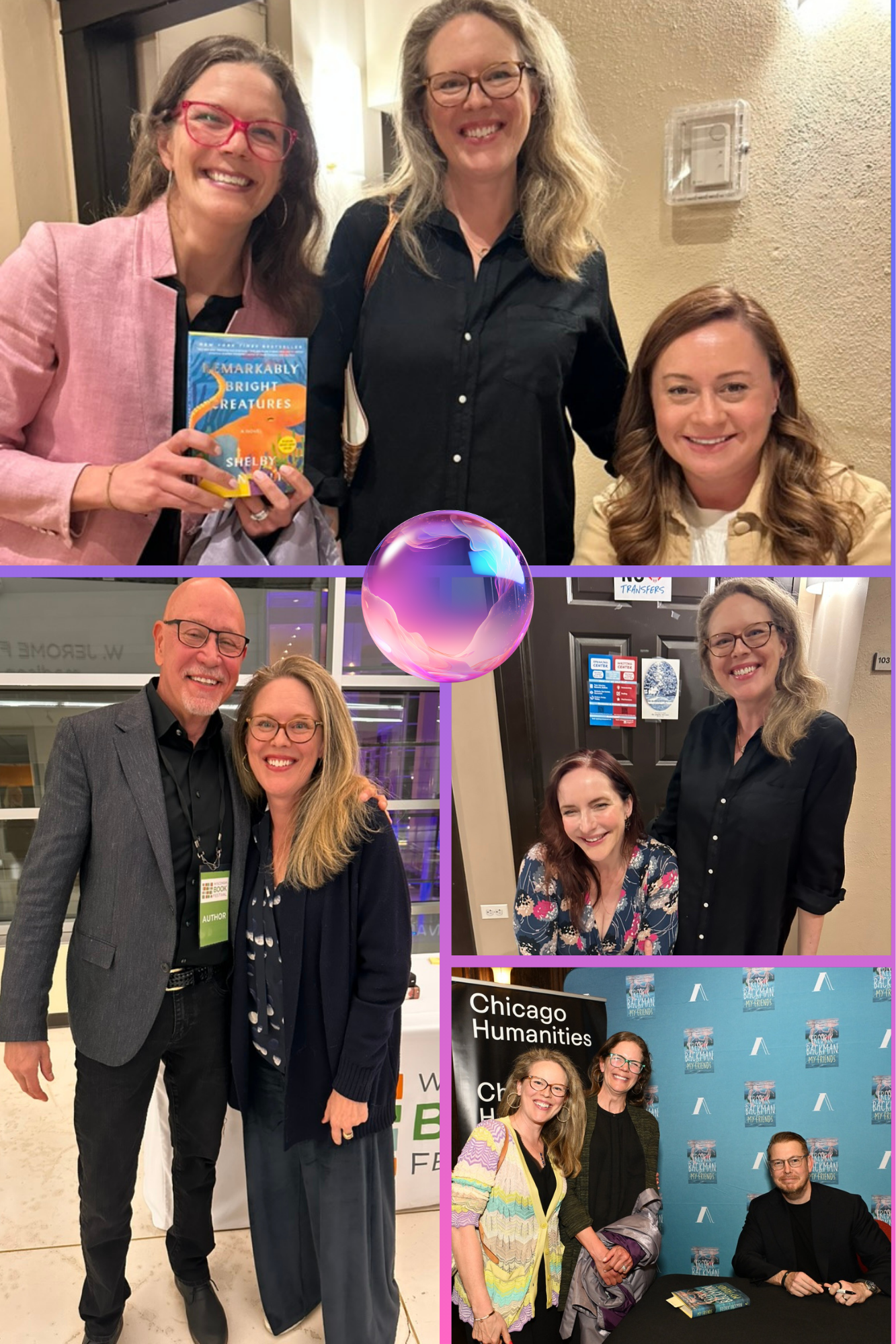
My writing homies: (clockwise from the top) Shelby Van Pelt, Rebecca Makkai, Fredrik Backman, and David Wroblewski
4. I (Almost) Got Scammed!
This year, I received an email from Danielle Steel telling me how much she enjoys my books and wants to know more about my writing journey! For a full day, I thought: Wow. This is really it. All my efforts at building my platform like that one agent told me I had to do have really paid off.
I started to respond, my email bursting with enthusiasm until I realized: I have published exactly zero books. I have 110 Instagram followers. Danielle Steel ain’t emailing me about nothing.
A quick Google search confirmed this is a scam by enterprising con artists (possibly based in Nigeria) using AI! They seek to get desperate writers (see #1 above!) to pay for their help finding an agent or publicity. The Authors Guild now maintains an entire page of publishing scam alerts, many AI-powered. Personally, if I were a scammer, I'd do something easier than researching author websites, saying I like their work, talking to them about writing, then playing a long game to get them to pay me. It all seems too convoluted and effortful. But here we are!
Next year’s takeaway: Use an AI-checker (like GPTZero) on every random email before wasting my time replying. But keep a file of these because they do make me feel rather official!!
3. Two Writer Friends Got Agents!
I met friends in different writing classes who got agents this year! I felt genuinely THRILLED for them. Also super jealous. Also hopeful! Perhaps I will make it through the slush pile one day and break through. Glossy-haired and lovely Shelby Van Pelt reportedly sent Remarkably Bright Creatures to the slush pile of her agent (who has, in fact, already rejected me, in case you were curious).
If they can do it, maybe I can too!
2. I Realized What "Balanced" Might Actually Mean
After years of all-or-nothing working (thank you BigLaw), I'm slowly learning that writing doesn't have to be that way. I don't need to take every class or no classes. I don't need to query 100 agents in one week or give up entirely. I don't need to write 3,000 words every day or delete my manuscript. I don’t need to manically plan posts for social media then delete the apps when I look at analytics and realize it’s screaming into the void.
I can just... show up every day. Do the work. Learn what I need to learn. Be patient with the process. Realize I can only do 3-4 hours of super focused writing per day. Period.
This is MUCH harder than it sounds for a recovering Type A lawyer. But I do need to temper my all-in, balls to the wall desires by realizing literally no one is paying me to write (right now), so I mustn’t burn out yet! (It was rather easy to justify periods of burn-out on my BigLaw partner’s salary, lol).
Next year’s plan: Put my biglaw butt-in-the-chair every day but only for 6 or so hours and only 5 days a week so I have ample time to refill my creative well and live in the world so I can get more story ideas. Also I need to schedule in time for yoga and other creative cross-training which will make me a healthier and happier human which is kinda the whole point of me retiring from my partnership in the first place.
1. Even With All the Rejection and Solitude and Scams and AI Threats and a Dying Industry... There's Nothing Else I'd Rather Do!
After two years of doing this every day, treating it like a profession while still feeling a spiritual calling, losing myself in flow state time and time again—even with everything working against this choice (i.e., publishing layoffs, reading declines, oversaturated marketplaces, all the rejections)—there is nothing else on earth I'd rather do right now but write novels.
I am so glad I can!
Twenty-one years of biglaw taught me how to be an expert, and I was well-compensated for working my booty off to the point of complete and utter burn-out. Two years of writing have taught me what it feels like to be fully alive in my work, and the strong desire to manage this new career like a marathon versus a sprint.
To date, this has all been voluntary, unpaid and without any guarantee of commercial success. And I feel like I'm doing what I was always meant to do.
That's the only lesson that really matters.
Here's to year three. Let's see what happens!!
Thank you for reading!