The Loneliness of Sonia and Sunny by Kiran Desai: Book Review and Craft Tips
Part of my ongoing series Reading as a Writer to study what resonates with me as a reader and what craft tips I learned as a writer—and how debut authors like me can hopefully position their work for success!
Published: September 23, 2025
Genres: Literary fiction, Saga
Publisher: Hogarth (PRH imprint)
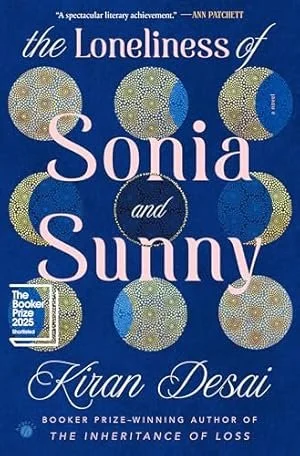
Kiran Desai spent nearly two decades working on this Booker-shortlisted, 688-page meditation on the specific loneliness that comes from figuring out your identity, seeking belonging, and choosing to make writing your entire life.
It also asks, what kind of novel can you make with twenty years that you cannot make with two? This question haunts every page of The Loneliness of Sonia and Sunny by Kiran Desai. The answer: you can build a world so densely textured, so richly observed, it feels like the reader's actual memory rather than invention, and keeps them company for hours of reading and beyond.
The Premise
The novel follows two young Indian writers: Sonia, a student in Vermont, and Sunny, a journalist in Brooklyn. It alternates between their POVs and explores how they each navigate the specific dislocation of being Indian immigrants in America caught between family and cultural expectations and personal desire.
It is also an intergenerational tale featuring the characters’ mothers, fathers, grandparents, aunts, lovers, and friends. It flits from Vermont to Brooklyn to India to Italy to Mexico, as the two characters' lives intersect and diverge and intersect again. What’s more, there are ghost hounds! A sacred amulet! An abusive relationship with a rich, older artist! MURDER! And many real estate transactions.
One might say there is a LOT going on in this novel. Yet I can still remember most every passage weeks after reading.
(For those who haven't read it: stick with it! It took me a while to warm up and figure out the myriad of characters, but once I did, I was in it for the long-haul.)
Reading as a Writer: The Craft of Accumulated Time
The narrative mostly takes place in the 1990s and 2000s. There are quick, sharp moments—a family conversation about arranged marriage, a meet-cute on a train, the particular humiliation of one's married boyfriend's wife returning to their home.
There are also long, sprawling passages that unspool across continents and decades, going back generations, where you feel the weight of all the years (very similar to Desai’s last novel, The Inheritance of Loss).
Pacing-wise, the narrative doesn't rush. It can't! It's been marinating for two decades. Though some of the sections feel more rapid-fire than others, the story ebbs and flows over time and space, and in some senses, 688 pages didn’t feel like enough.
Loneliness as a Form
What's remarkable from a craft perspective is how Desai handles loneliness not as a mood but as a form. NPR called the novel "abundant as life itself," and that abundance comes directly from the accumulation method Desai describes in interviews—journaling for years, sorting through thousands of pages, letting subplots emerge and then cutting them away. The novel reads like geology: layers of sediment compressed over time into something solid and strange and beautiful.
She uses loneliness the way other writers use weather—an atmosphere that shapes everything. Characters are alone in crowds, alone in relationships, alone in their own families. But the loneliness isn't pathological; it's observational. As the Chicago Review of Books notes, to be alone in this novel is to be understood. The solitude creates the space for seeing clearly. The loneliness itself might be the main character.
The Writing Life: Twenty Years of Nothing Else
Based on interviews, since winning the Booker Prize in 2006, Desai lived in what Publishers Weekly called a "semi-hermetic existence" to draft this one. She worked in residencies around the world including Tuscany. She kept journals constantly. She drank coffee, read books, and then wrote some more. She accumulated 5,000 manuscript pages at one point! She lived inside her characters' lives so completely that she described it as a "time warp" where she barely noticed the years passing.
Here's what she didn't do: work a 9-to-5, deal with a husband, raise children, maintain a "balanced life," or write for an hour a day and call it enough. She went ALL IN. She focused almost entirely on her writing.
Desai reportedly learned this approach from her mother, writer Anita Desai, who wrote every morning while her children were at school and "lived a life of silence."
As an all-or-nothing thinker who enjoys nothing more than total, immersive obsession (i.e., a workaholic), this is the kind of writer I aspire to be! The discipline! The ritual! The focus! I love it!
The Privilege and the Choice
Do most writers long for this vast expanse of open time? I think so. Do most writers get this? Hell no. Most every writer on every podcast, blog, and social media complains of the lack of time and attention for writing because of other busy aspects of their life. They talk of the challenges of writing while parenting, writing while teaching, writing while working, writing on lunch breaks and stolen hours and at kids’ soccer practices.
To live a life of only writing requires extreme sacrifice and/or extraordinary privilege. Desai likely could spend twenty years on a book because her last novel won the Booker Prize and was an international bestseller (!) and she probably received a sizeable advance from her publisher. She also secured prestigious writing residencies in Tuscany and elsewhere.
After twenty years in BigLaw, I too have some financial freedom and I realize this is not the reality for most writers. Not worrying about bills or kid stuff definitely informs what kind of work becomes possible.
But for those of us who have financial security, there's still a choice to make about how to use that freedom. Do we treat writing as one activity among many—a hobby? Do we balance it along with our other responsibilities and write for an hour or two daily? Or do we give ourselves permission to make it everything?
The Loneliness That Connects
Desai titled her novel The Loneliness of Sonia and Sunny for a reason. The writer herself and her two writer characters all suffer from it. Probably most writers suffer from it occupationally. I certainly do, especially compared to the chaos of BigLaw commutes and meetings and constant travel, and the collaboration of working with huge teams and clients and consultants.
But here's the paradox: that loneliness, when transformed into art, becomes the opposite of lonely: it becomes connection. When I’m writing, I feel less alone, and reading this novel, I felt less alone. That is the magic of this art form. It helps us connect even when it requires solitude to create and consume.
The Loneliness of Sonia and Sunny is proof that Desai’s approach worked. She once again produced something spectacular and abundant and weird and unforgettable, something that helps readers feel less lonely precisely because the writer was willing to be so profoundly, productively alone.
What a glory. What a luxury. What a way to spend twenty years!