Tradwives, Girlbosses, and Yesteryear | Book Review
Reading as a Writer Book Review + Craft Tips
This Spring I went down a Yesteryear rabbit hole. Even though I’m not an “online person,” the buzzy pitch lured me in: a tradwife mega-influencer wakes up one day in the 1850s and has to figure out why.
Genre-bending with elements of satire, horror, historical fiction, literary and suspense, Yesteryear is Caro Claire Burke’s debut novel and it was propelled by a killer marketing campaign including the fact Anne Hathaway bought the film rights based on a first draft.
I read the novel twice with my eyes, listened to the audiobook and attended the author’s Chicago-area event. Here are some craft observations reading this novel as a writer.
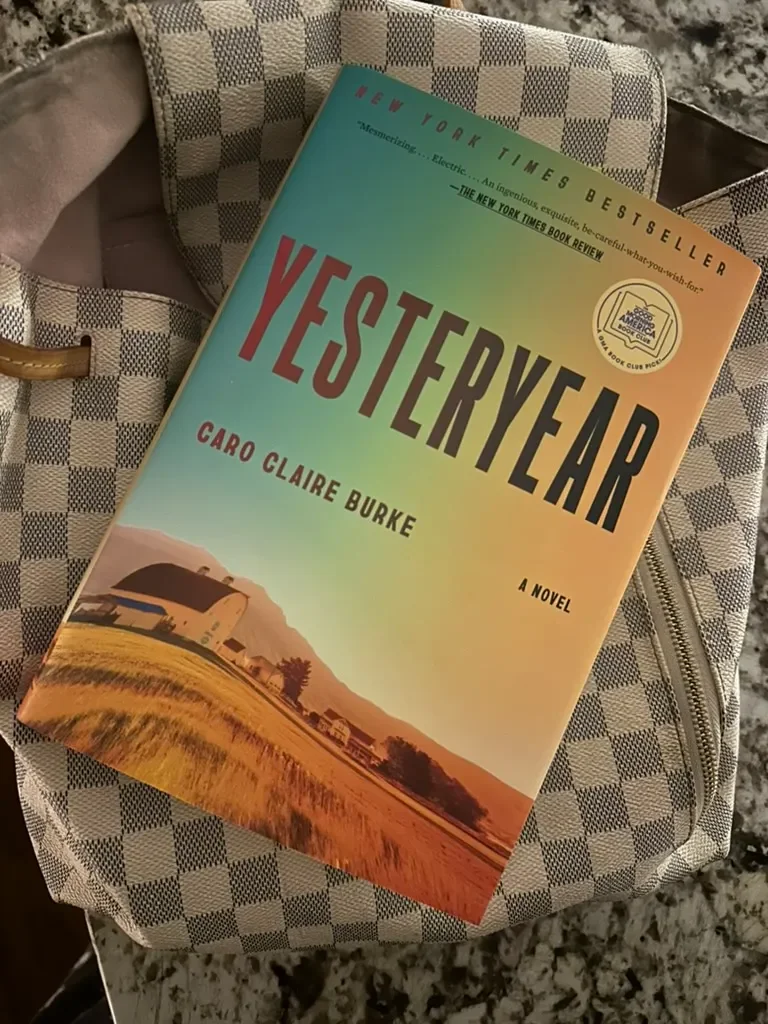
*A FEW SPOILERS FOLLOW!*
READING AS A WRITER: YESTERYEAR BOOK REVIEW
The Premise
The novel’s protagonist, Natalie, is a conservative, religious tradwife influencer1 with millions of followers and a diabolically snarky inner monologue. She marries the dud son of an American political dynasty, moves to a farm, and posts her life on Instagram, attracting a huge audience including “angry women” who follow her account specifically to leave negative comments.
One day, Natalie wakes up in the 1850s on a farm with children who are not her own and a husband who is not her husband, and has to figure out how and why.
Arc of the Protagonist
The bulk of the novel alternates between Natalie’s attempts to figure out how she ended up in the pioneer days and flashbacks of her earlier life, creating a patchwork of facts that help us understand her inner life and motivations. She grew up as a religious, antisocial girl with a complicated home situation and went to Harvard. There, she got married and pregnant, dropped out and moved to a farm where, unsatisfied with her husband, she created an Instagram page.
With each milestone of Natalie’s life (engaged, pregnant in college, buys a farm, starts her Instagram, impregnates herself with a turkey baster. . .), she measures herself against her liberal-girlboss Harvard roommate Reena’s trajectory. These women—collectively, girlbosses—form a counterpoint to the characterization of the protagonist. She derides their choices throughout the novel, and becomes obsessed, especially with the women who comment negatively on her posts.2
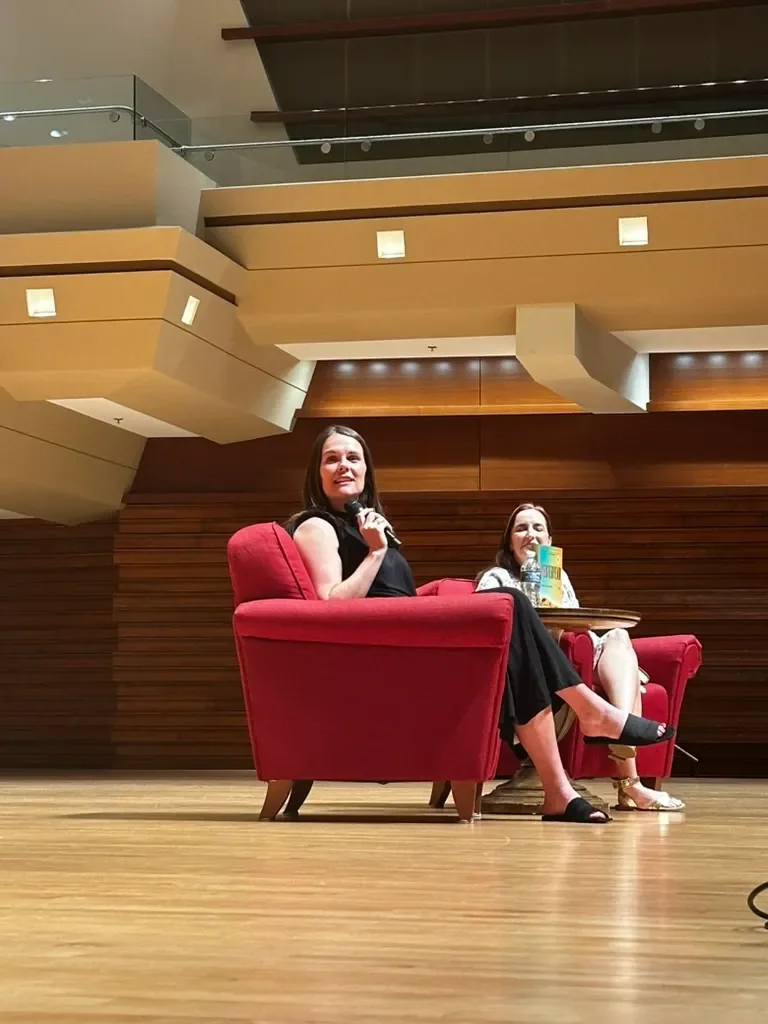
The author, Caro Claire Burke (L) and moderator Rebecca Makkai (R) at Anderson’s Bookshops event in Naperville, IL
The Structure
The structure of the novel is rather genius: it is organized in three parts consisting of part one: a single day / part two: the past and present interwoven with flashbacks / and part three: another single day. In the middle section, Burke alternates between Natalie’s “before” life and her “after” timeline, i.e., her present-day life in the 1850s. A third thread runs throughout each of the parts: snippets of an interview between Natalie and an unknown interviewer.
The structure itself adds to the disorientation and mystery of the novel.
The ending is both straightforward and deeply ambiguous and forced me right back to the beginning to re-read. Questions about Natalie’s sexuality and mental health are raised but not resolved. Drug use is one of the novel’s most shocking plot devices (and there are many others).
Some readers found the ending rushed or unsatisfying. I found it gut-punching. The final lurch of WTFs at the end felt exactly right though I could have read another 500 pages (hence, going back to re-read it all over again).
Tension and Suspense
Long ago I learned in writing classes the importance of dramatic irony to reliably produce tension in a piece and this tension is baked into the very premise and setting.
The novel moves from satire to thriller after the first part, which sets up the facade and performance of social media, and gives us a taste of the awesomely dislikable character. Once we’re in the “past", the stakes are life-or-death and we need this charismatic/horrible Instagram influencer to solve the mystery.
The moral instability of the antiheroine narrator is its own engine. The first person POV grants access to her interiority and further contributes the cognitive instability because she is complicated and angry and ambitious and judgmental. She espouses conservative Christian views yet curses like a sailor, etc. Her Instagram page is a devotion to family and motherhood, yet she hates being a mom.
She is fascinating.
And contrary to most characters in contemporary fiction, she is not a character who changes over the course of the novel. There’s no real closure or insight at the end, which was very brave of Burke — and reflective of real life.
Some people are just terrible.
The tension rises right to the last page, and on a second read, you can see how skillfully Burke designed the puzzle pieces to get us from the hook to the ending. And the books’ brilliance is best found in how Burke weaves together a multitude of themes which drive the narrative forward.
Eagle-eyed readers will see Gemma perched in the background on her bedroom cat tree
The Divisive Themes: TradWives v. Girlbosses
Like most great novels, Yesteryear ripples with symbolism and themes: religion, feminism, power, identity, misogyny, motherhood, capitalism, online culture, performative womanhood, mental illness, sexuality, political tribalism, etc. Many of these topics stoked the online discourse and debate about the novel, particularly its depiction of conservative Christians and its political stance.
But the Millennial author’s core argument, as I read it, is that women are pretty much doomed regardless of what they choose. The pursuit of purpose as a perfect conservative wife and mother (Natalie) or a perfect liberal career woman/girlboss (Reena) are both failed projects, and not because the women fail, but because the projects are impossible.
Having spent over twenty years in BigLaw, I’ve lived the “girlboss” version of ambition and have countless mentors, friends, family, colleagues and clients who modeled what it’s like to kick ass in one’s career and have a fulfilling family life.
Of course the systemic barriers are real but the binary itself is the fiction. Tradwife OR girlboss. Doomed if you stay home, doomed if you don’t. I’ve watched women make partner and raise remarkable children. I’ve watched women stay at home with their families and create amazing lives. I’ve watched women walk away from lucrative careers to do something that mattered more to them personally—and vice versa.
None of the women I know IRL fit Natalie’s binary taxonomy, and neither do I, but the binary propels the pace and amps up the tension. And the irony of it all, of course, is that Natalie is both: she’s monetizing her tradwifery like a girlboss to the extreme.
Conclusion
Some readers interpret the book as tradwife gets what she deserves. But none of the characters win—not even the rich, idiot husband Caleb who has a tender heart and cannot pursue his dreams of teaching kindergarten because of Natalie’s insistence on getting a more masculine job.
The conclusion that ambitious women face impossible choices — tradwife or girlboss, and neither are fully available — is reductive, and deliberately so. That provocation is the point. That kind of debate is what moves copies. But Yesteryear’s success also proves that (most) readers can handle nuance and unlikeable female protagonists and genre-mashups.
In my own work, I find myself exploring the same themes of how to find purpose as an ambitious woman and Yesteryear inspires me on many fronts: to play with structure to maintain a propulsive pace. To consciously set up counterpoints with my characters but trust my readers are smart enough to appreciate nuance.
And, of course, to position myself so Anne Hathaway or a similar Academy-Award winning actor can buy the film rights to my debut novel. To that end, if any actors out there want to play a tenacious female founder drawn into the orbit of a glamorous angel investor who isn’t who she seems, hit me up!
I have a manuscript ready to go. :)
1 I had to look up the influencer on whom the novel is apparently based: Hannah Neeleman, @BallerinaFarm. Fair warning: her posts about her nine children, bread-baking and luxury farm are genuinely hypnotic, as evidenced by her ten-plus million followers.
2Scrolling through the aggressively-hateful comments on the above influencer’s posts truly made me lose faith in humanity and question how people have so much time on their hands!